If you've started researching how to clean your home's exterior, you've probably run into two terms that get used almost interchangeably: soft washing and pressure washing. They sound similar, and both involve spraying water at dirty surfaces — but they are not the same service, and using the wrong one on the wrong surface can cause real, expensive damage.
Here's a clear breakdown of what each method actually does, when to use each one, and how to tell which your home needs before you hire anyone (including us).
What Is Pressure Washing?
Pressure washing uses a machine to force water out at very high pressure — typically 1,500 to 4,000+ PSI (pounds per square inch) — to physically blast dirt, grime, mildew, and stains off a surface. It relies almost entirely on mechanical force. There's no cleaning solution required, though pretreatment is often used to loosen tough stains like oil or rust first.
Because it's so forceful, pressure washing is ideal for hard, durable surfaces that can take a beating without being damaged:
- Concrete driveways and walkways
- Poured concrete patios and pool decks
- Brick pavers
- Sealed wood or composite decking (at a reduced, controlled PSI)
- Commercial sidewalks and building entrances
The tradeoff is that this same force can gouge wood, strip paint, crack shingles, and force water into places it was never meant to go — which brings us to soft washing.
What Is Soft Washing?
Soft washing flips the equation. Instead of relying on brute force, it uses low water pressure — often no stronger than a garden hose — combined with a specially formulated cleaning solution (typically a diluted blend that targets algae, mold, mildew, and organic growth). The solution does the actual cleaning work by breaking down the growth at the root; the low-pressure rinse simply washes it away afterward.
This makes soft washing the right choice for surfaces that are more delicate, porous, or vulnerable to water intrusion:
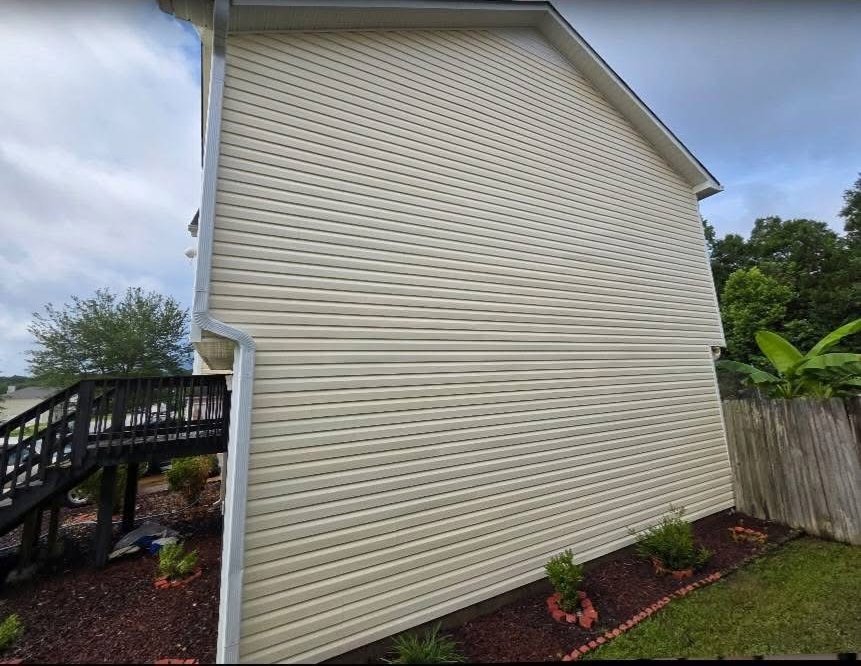
- Vinyl, wood, stucco, and fiber cement (Hardie board) siding
- Asphalt shingle and metal roofing
- Brick and mortar
- Painted surfaces, trim, and fascia
- Delicate outdoor structures like fencing and pergolas
Because soft washing kills mold and algae at the root rather than just knocking visible growth off the surface, the results also tend to last significantly longer than what you'd get from blasting the same surface with high pressure.
The rule of thumb: if high pressure could damage it, soft wash it. If it's built to take a beating, pressure wash it.
Key Differences at a Glance
| Pressure Washing | Soft Washing | |
|---|---|---|
| Water Pressure | High (1,500–4,000+ PSI) | Low (comparable to a garden hose) |
| Cleaning Method | Mechanical force | Chemical solution + light rinse |
| Best For | Concrete, pavers, sealed decking | Siding, roofs, brick, painted surfaces |
| Kills Mold/Algae at Root? | No — removes what's visible | Yes — treats the growth itself |
| Risk to Delicate Surfaces | High (cracking, water intrusion, stripping) | Low |
| How Long Results Last | Shorter — regrowth can return quickly | Longer — root-level treatment slows regrowth |
Which One Does Your Home Need?
In most cases, a full exterior cleaning actually uses both methods on the same visit — soft washing for the siding and roof, pressure washing for the driveway, walkways, and patio. Here's a quick surface-by-surface guide:
- Vinyl or wood siding: Soft wash
- Asphalt shingle or metal roof: Soft wash
- Brick exterior: Soft wash
- Concrete driveway or sidewalk: Pressure wash
- Wood or composite deck: Pressure wash at a controlled, lower PSI
- Pool deck or paver patio: Pressure wash
The Risk of Using the Wrong Method
This is where things get expensive if you (or an inexperienced crew) get it backwards.
Pressure washing siding or roofing can force water behind panels and under shingles, leading to hidden mold and rot that doesn't show up until months later. On asphalt shingles specifically, high pressure strips away the protective granules that shield the roof from UV damage — which can shorten the roof's lifespan and, in some cases, void the manufacturer's warranty outright.
Soft washing a driveway, on the other hand, usually won't cause damage — it just won't get the job done. Low pressure isn't enough to lift ground-in tire marks, embedded oil stains, or years of compacted grime from concrete. You'll end up paying for a service that doesn't solve the problem.
That's why the method matters as much as the company doing the work. Anyone can point a machine at your house — the value is in knowing which machine, at what pressure, with what solution, for which surface.
Frequently Asked Questions
Can I pressure wash my siding instead of soft washing it?
Is soft washing more expensive than pressure washing?
Which method should I use on my roof?
Which method should I use on my driveway?
The Bottom Line
Soft washing and pressure washing solve two different problems. Soft washing protects and deep-cleans the delicate, porous surfaces on your home — siding, roofing, brick, and trim. Pressure washing tackles the tough, durable hardscapes that need real force to come clean — driveways, patios, and decks.
At Rescue Wash Pros, we use both, matched to the surface, on every property we service across Columbus GA, Auburn AL, Opelika AL, Phenix City AL and Fort Mitchell AL. If you're not sure which your home needs, that's exactly what a free quote is for.